
Robert Borbás, universally known as Grindesign, is one of those artists who never stop questioning their own work. And while his illustrated universe continues to grow, it is in tattooing that he has undergone the most profound transformation in recent years.
“I’m really starting to understand what works on skin and what belongs to the world of illustration,” he says. “The two have always gone hand in hand for me, but I had to learn to separate them in order to get the best out of both.”

This shift in awareness has had a direct impact on his technique. Borbás has begun integrating new solutions, such as softer grey washes and more nuanced tonal variations. “Working with softer tones has helped me create tattoos that are more defined, more readable, and with far more effective contrast,” he explains. It’s a change that doesn’t dilute his dark imagery but makes it more suitable to stand the test of time, visually stable, and even more powerful in its impact.

The evolution concerns not only technique but also the construction of his subjects. Over the last five years, Borbás has created a small pantheon of creatures inspired by the Hungarian figure of the LIDÉRC, a demon associated with sleep paralysis. “I struggled with anxiety and sleep paralysis for years,” he admits. “Drawing these creatures and building little stories around them helped me enormously. It’s always been a form of therapy for me.” Once transferred onto skin, these beings become part of a personal ritual in which darkness is controlled, transformed, and made shareable.

This sense of maturation has unfolded alongside another key milestone in his career: ten years of running his studio, Rooklet Ink. “Running a shop changes you a lot,” he says. “Being surrounded by the right people, by creative and passionate colleagues, is a privilege. And after ten years of work I felt people were beginning to take what I do even more seriously.” That’s why, in recent years, he has slowed down on guest spots and travelling, choosing instead the calm of his own environment. “I used to travel a lot, but at a certain point I realised I’m far more productive and much calmer if I stay at home. And leaving my family became harder and harder.”

His routine today follows healthier rhythms. “I usually tattoo four days a week and dedicate a full day to illustration,” he explains. “I try to rest at weekends, although that’s not always possible. And I’ve stopped drawing until two or three in the morning: now I strictly stop at eleven.”

Even though he continues to work on several projects at once, Borbás has learnt not to confuse the languages he works in. “Illustration helped me a lot in the beginning. But then came the moment to truly understand the unwritten rules of tattooing. You can learn the basic technical skills in a few months; creating a good design with genuinely effective technical solutions—that’s the hard part.”

Today Borbás finds himself in the midst of an intense creative period, working on collaborations with bands like Gojira and on projects with streetwear brands. But what defines him most right now is a mixture of discipline, introspection, and renewed confidence. “This is a new chapter for me,” he says. “Perhaps the first time that, through art, I openly talk about my anxiety and how I’ve dealt with it. Art is a cure, but you have to know how to navigate the hard times.”
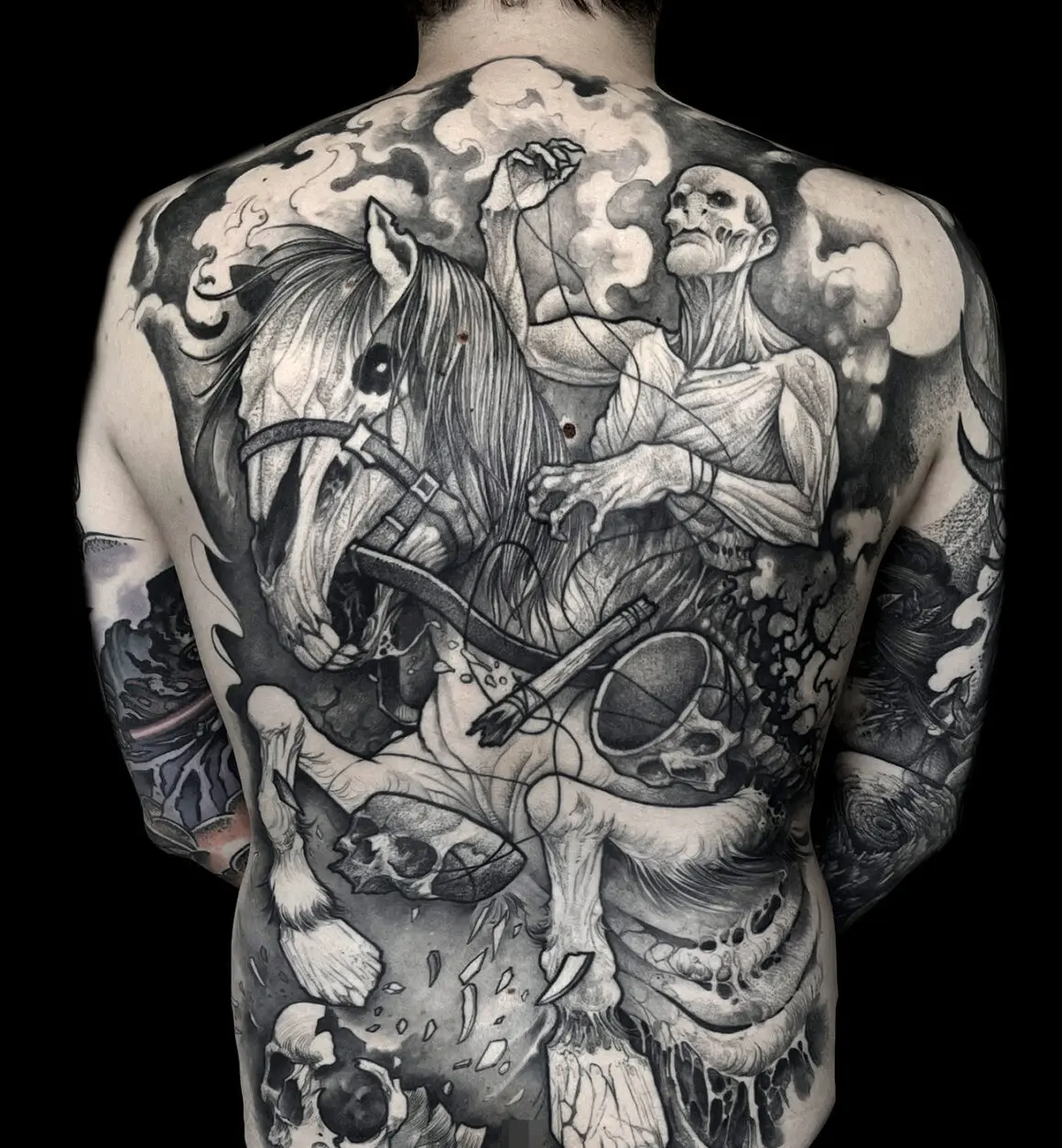
It is in this balance between darkness and technical clarity—between inner demons and the precision of tattoo craft—that the heart of Grindesign’s tattooing lies today. A language that continues to evolve without ever losing that unsettling force which has made him one of the most recognisable names on the international scene.

INCUBUS – The Art of Grindesign by Robert Borbas
With over 285 pages including linework, sketches, and graphic imagery – many of which have become iconic album covers for metal bands – INCUBUS delves into the world of classic subjects such as demons, skulls, crosses, goats, and irreverent religious iconography. These are joined by the evil spirits that define his visual language and bring to life his very own Lidérc – his nightmare…
The post The dark imagery on skin by Robert Borbás appeared first on Tattoo Life.
Leave a Reply